
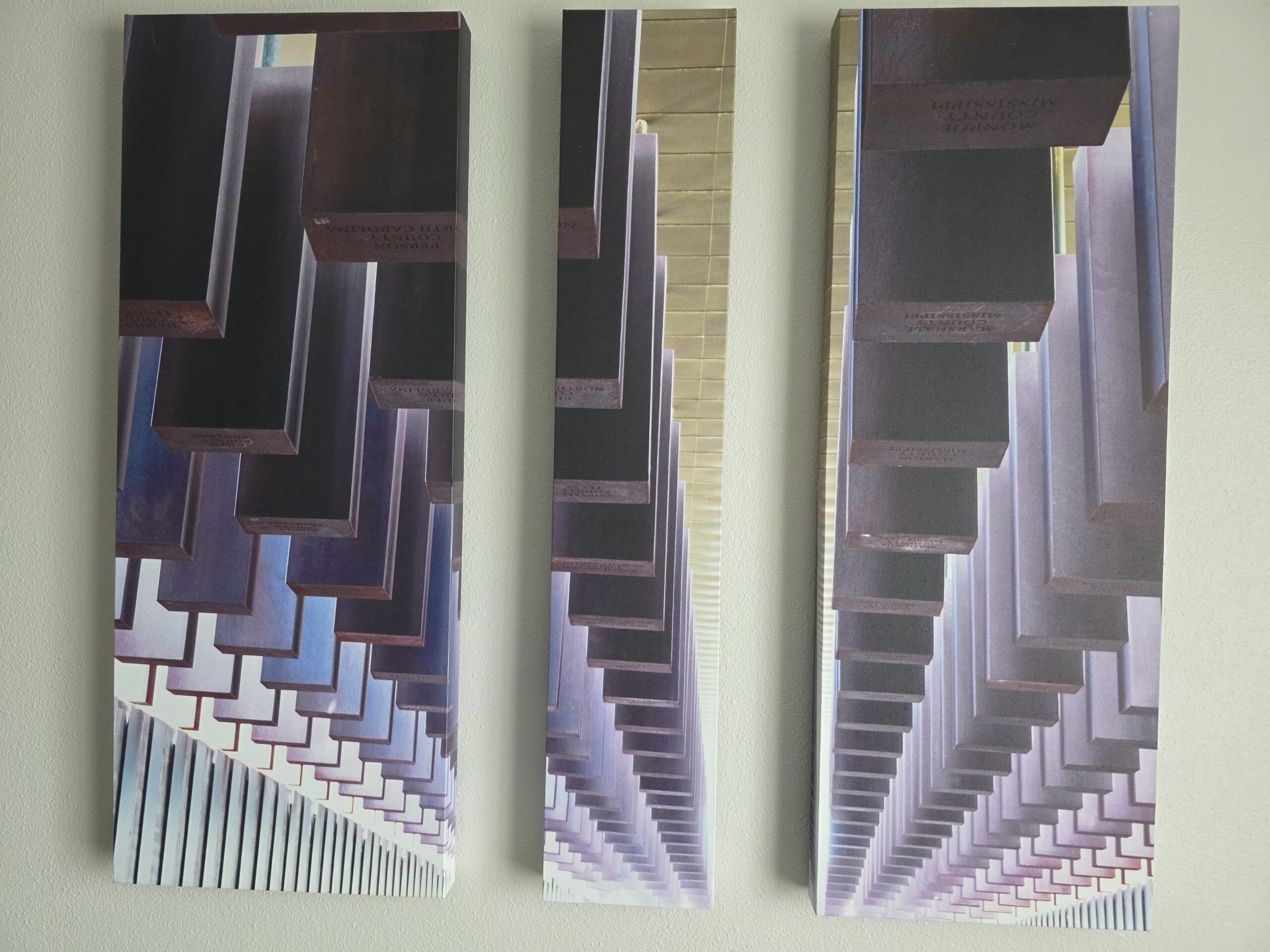

Have you ever had something right in front of your eyes that was so surreal once you were able to recognize what it was?
It was placed in an inconspicuous place in the outer room of the bedroom, behind the couch, with my back to it.
This is what happened to me on May 25, 2026, which was Memorial Day 2026.
I was in a hotel, about to head home from a retirement party that I attended the night before, when it appeared.
I was as if I had seen this before, but didn’t pay attention until my spirit inside of me said look again, and this time open your eyes.
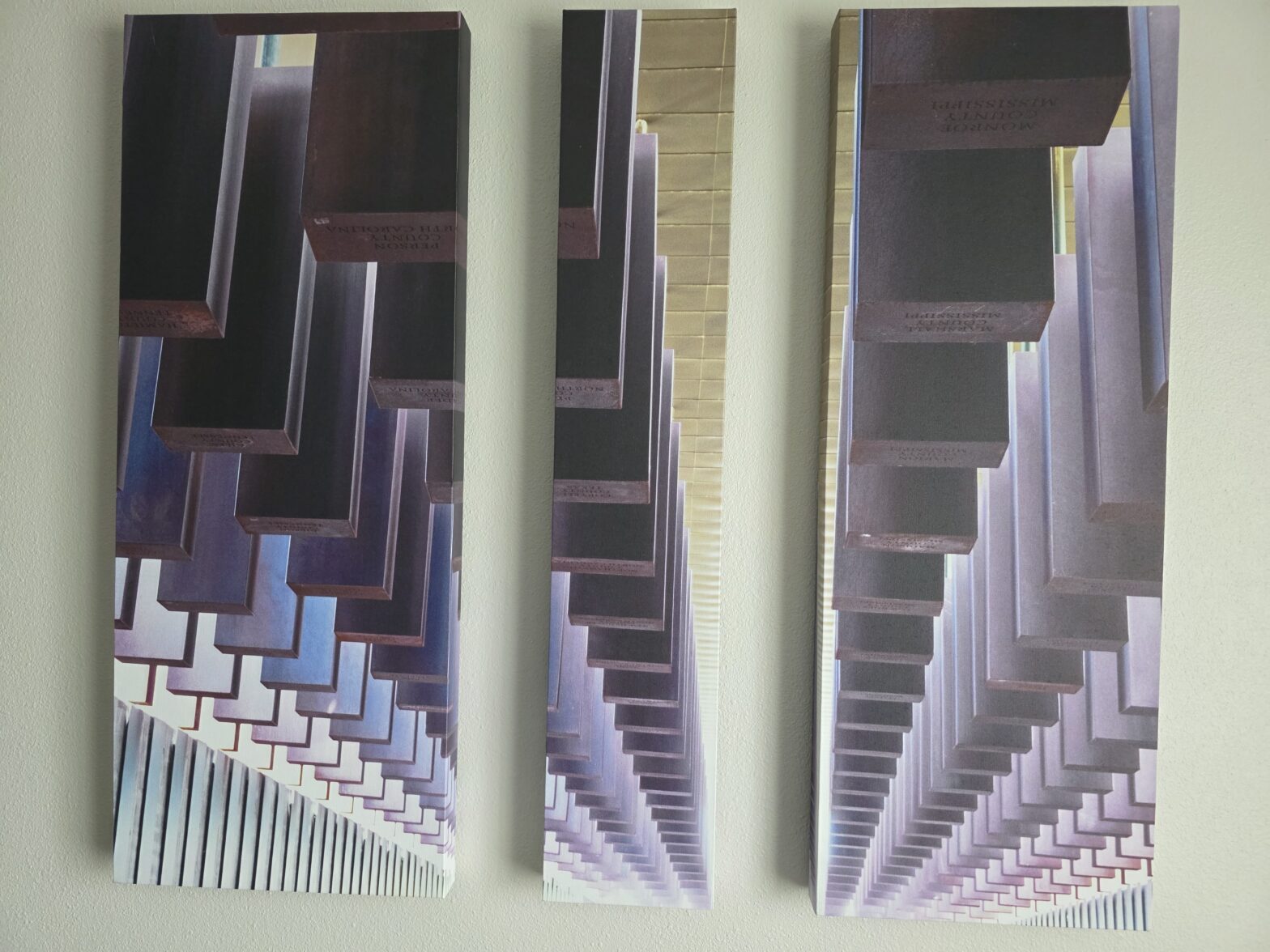
The picture was a replica of a three-panel canvas of the Lynching Memorial at the National Memorial for Peace and Justice by Equal Justice Initiative (EJI) in Montgomery, Alabama, hanging on the wall of my suite. No pun intended.
It represented the names of those who were lynched years ago, as I could somewhat make out the Counties of the names at the bottom.
“EJI researchers documented 4,075 racial terror lynchings of African Americans in Alabama, Arkansas, Florida, Georgia, Kentucky, Louisiana, Mississippi, North Carolina, South Carolina, Tennessee, Texas, and Virginia between 1877 and 1950—at least 800 more lynchings of Black people in these states than previously reported in the most comprehensive work done on lynching to date.”
“The lynching of African Americans was terrorism, a widely supported campaign to enforce racial subordination and segregation. Lynching in America documents more than 4,400 racial terror lynchings in the United States during the period between Reconstruction and World War II.”
I took a moment of silence to honor what I saw and reflect on it during my visit to the National Memorial for Peace and Justice (Equal Justice Initiative) in Montgomery, Alabama.
As I took a moment to ask myself why this is in the hotel, I wondered if I might be able to purchase a replica for my home to tell the story.
I’m sure many who stayed in this particular suite had no idea what the picture or the collage of the three canvases represented.
However, I knew exactly what it was based on my recent visits over the last three years.
Knowing that I was physically in Montgomery, Alabama; however, I would have loved to see literature explaining why it was in the room and where they could see the real thing.
I won’t mention the name of the hotel, as I’m sure I will stay there again at some point and request that suite if available.
The fact that I was able to see this picture, a three-part image on canvas of The National Memorial for Peace and Justice (Equal Justice Initiative), Montgomery, Alabama, still amazes me that I clearly recognized what I was seeing.
Now, after seeing that image, I wonder what else has been in front of my eyes that I was blind to see?
Knowing that this image is rarely spoken about, particularly in the day and age we live in, with lynching being so prominent in the South.
Lynchings in the South were a form of racial terror used to enforce white supremacy, primarily targeting African Americans from the post-Civil War era through the mid-20th century.
“White Americans used lynching to terrorize and control Black people in the 19th and early 20th centuries. Learn more about the history of this barbaric practice and how the NAACP worked to end lynching.”
History of Lynching in America | NAACP
If you have never visited any of the museums, memorials, or monuments associated with the Equal Justice Initiative in Montgomery, Alabama, I highly recommend you do so. I spent hours there.
The Legacy Museum – The Legacy Sites
What the picture really represented was the ultimate form of what Dr. Koritha Mitchell calls “Know your place aggression.”
3.9 Koritha Mitchell on Coming to Terms with Know Your Place Aggression.pdf
Today, I challenge you to take a moment to reflect on the places you have visited and how well you understood what you saw. What might you deem an “Inconspicuous Place”
“All the secrets of the world worth knowing are hiding in plain sight.” ~ Robin Sloan
“There is an old saying: If you want to hide the treasure, put it in plain sight. Then no one will see it.” ~ Larry Dossey
“The way to right wrongs is to turn the light of truth on them.” ~ Ida B. Wells

Enlightening
Tim,
Yes Sir!
CM
The array of emotions that reverberated through your mind and soul upon recognizing what you were observing and the moments you took in reflective silence reminds me of the impact that I felt when visiting the National Museum of African American History and Culture. The abject cruelty experienced by generations of African Americans can leave you numb and demoralized. However, the National Museum of African American History and Culture also boldly illustrates our immense and numerous triumphs against monumental odds. So, I was able to depart more uplifted than saddened knowing that there is a magnificent museum that shows a complete history of the special character, resilience, and resolve of the our people.
Sam,
The words you wrote today are uplifting by finding the positive in the negative. Sadly, many who aren’t part of our generation don’t realize what our forefathers went through to get here. It was not that long ago yet, I wish more people would take the time to visit the National Museum of African American History and Culture.
McKinley
I have read about this place, and would like to visit the Lynching Memorial soon.
Scott,
Greetings, You will need a couple of hours.
It’s amazing!
McKinley
I took my family to the Legacy Sites on Spring Break last year. We spent over half a day and still felt rushed. It’s something everyone should see, imo. We forget our history too soon.
Grady,
Greetings,
Thank you for sharing your experience.
I agree we “forget our history too soon.”
McKinley